

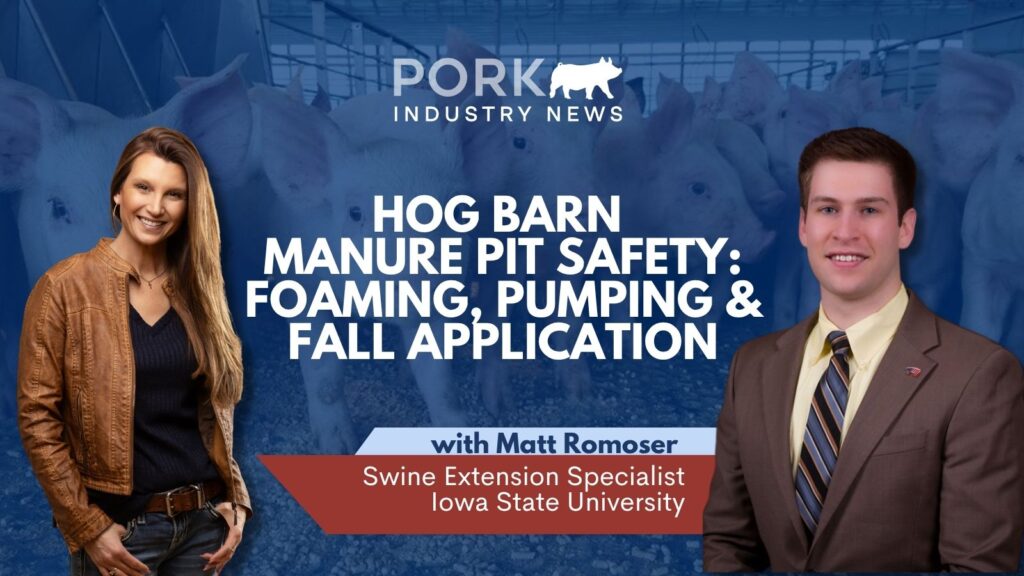
Hog Barn Manure Pit Safety: Foaming, Pumping & Fall Application with Matt Romoser
As harvest gets underway across Iowa, fall manure application season is close behind. For pork producers, that means managing a valuable fertilizer source while also paying close attention to manure pit safety, foaming, ventilation, hydrogen sulfide and application timing.
Matt Romoser, swine extension specialist with Iowa State University and the Iowa Pork Industry Center, joined Pork Industry News to discuss what producers should be thinking about before they begin pumping and applying manure this fall. Romoser works with pork producers across 20 counties in eastern and southeast Iowa.
Know the Fertilizer Value Under Your Barn
Manure represents significant fertilizer value for pork operations, but understanding that value begins with knowing its nutrient content.
Romoser said water conservation inside the barn can play a role in manure value. Excess water increases the volume producers must haul while diluting the concentration of nutrients in the manure.
Regular manure testing can help producers determine concentrations of nutrients including nitrogen, phosphorus and potassium. Nitrogen and phosphorus are particularly important when developing and following manure management plans.
Knowing those nutrient levels can also help producers make more precise fertility decisions and determine whether manure is providing sufficient nutrients for a field or whether additional commercial fertilizer may be needed.
Romoser encouraged producers to consider sampling before hauling and said samples can provide additional information to farmers.
When Is the Best Time to Apply Manure?
Soil temperature is an important consideration when deciding when to begin fall manure application.
Romoser said producers should generally aim for soil temperatures of approximately 50 degrees Fahrenheit and cooling. Cooler soil slows microbial activity that converts ammonium into nitrate, helping reduce the potential for nitrogen loss.
That recommendation can create a practical challenge during an already busy fall.
From a fertilizer standpoint, reducing nitrogen loss means more of that nutrient remains available for the following crop.
Cover crops and, in some circumstances, nitrogen stabilizers are additional management tools producers may use to reduce potential nitrogen losses. Romoser noted that southeast Iowa has producers using cover crops to help keep living roots in the soil and retain nutrients.
Hog Barn Pit Foam Can Create a Serious Safety Risk
One of the major safety issues producers may encounter before manure pumping begins is foam developing in a hog barn manure pit.
Romoser explained that manure pit foam can contain methane, a highly combustible gas. If the foam breaks and methane is released into the barn’s airspace, an ignition source can create a potentially dangerous situation for both people and pigs.
There isn’t a single solution that eliminates manure pit foaming. Romoser said microbial populations within the pit play a role in foam development and discussed management options producers can consider when dealing with a foaming pit.
If foam needs to be knocked down, controlling potential ignition sources and maintaining adequate ventilation become particularly important.
Romoser specifically cautioned about pilot lights, welding and repair work that could provide an ignition source. He also emphasized maintaining adequate airflow to exhaust released gas from the barn.
Hydrogen Sulfide Is Another Concern During Pumping
Methane isn’t the only gas producers need to consider.
Agitation can also increase the risk of exposure to hydrogen sulfide (H₂S).
At low concentrations, hydrogen sulfide may be associated with a rotten-egg odor. Romoser warned, however, that producers should not rely on smell to determine whether conditions are safe because the gas may no longer be detectable by smell at higher concentrations.
He recommends people working around barns and manure pump-outs wear a hydrogen sulfide monitor that can alert them to potentially dangerous concentrations.
Another important practice is creating headspace before agitation.
Romoser recommended pumping manure down before beginning agitation so there is space between the manure surface and the slats. That allows pit ventilation to more effectively exhaust gases and reduces the potential for hydrogen sulfide to move into the area occupied by pigs and people.
If someone enters a barn and finds pigs down during manure pumping, Romoser cautioned against immediately entering the building to attempt a rescue because the person could also be entering a dangerous atmosphere.
Check Pit Covers and Ventilation Before Pumping
Fall manure safety also includes equipment and ventilation.
Romoser encouraged producers to make sure pit fans and covers are in good working condition before pumping begins. Gaps or improperly functioning components can affect airflow and potentially allow gases to move into the pig space rather than being properly exhausted from the pit.
That makes checking ventilation systems, pit fans, covers and pump-out areas an important part of preparing for manure hauling season.
Communication Is Part of Manure Safety
Romoser’s top priority heading into fall manure application is safety.
That includes protecting against methane-related flash fires and hydrogen sulfide exposure, but it also means communicating safety protocols with everyone involved.
That communication becomes especially important when a manure hauling company, barn manager, caretakers and other employees may all be working around the same operation.
“We want to make sure that we’re taking care of our people first,” Romoser said.
At the same time, properly managing manure allows pork producers to utilize a valuable fertilizer resource while protecting soil nutrients and reducing the potential for nutrient loss.
Producers looking for additional information about manure management and fall application can find resources through the Iowa Pork Industry Center and Iowa State University Extension and Outreach. Romoser said manure-specific information is available within the environmental resources provided by the Iowa Pork Industry Center.
Watch the full interview with Matt Romoser with Rachel Fishback of Pork Industry News on AcresTV for free: https://acrestv.vhx.tv/videos/hog-barn-manure-pit-safety-foaming-pumping-fall-application-with-matt-romoser-pork-industry-news